

Track physical and financial progress
Progress shows you at a glance two numbers that rarely line up: how much of the job is actually built (physical progress) and how much of your budget you've already spent (financial progress). The screen puts them side by side, line item by line item, and flags them the moment they drift too far apart — which is exactly when it pays to take a closer look. You don't capture anything here or spend AI credits: everything is calculated live from the data you already have in Budget, purchases, payroll, and progress billings.
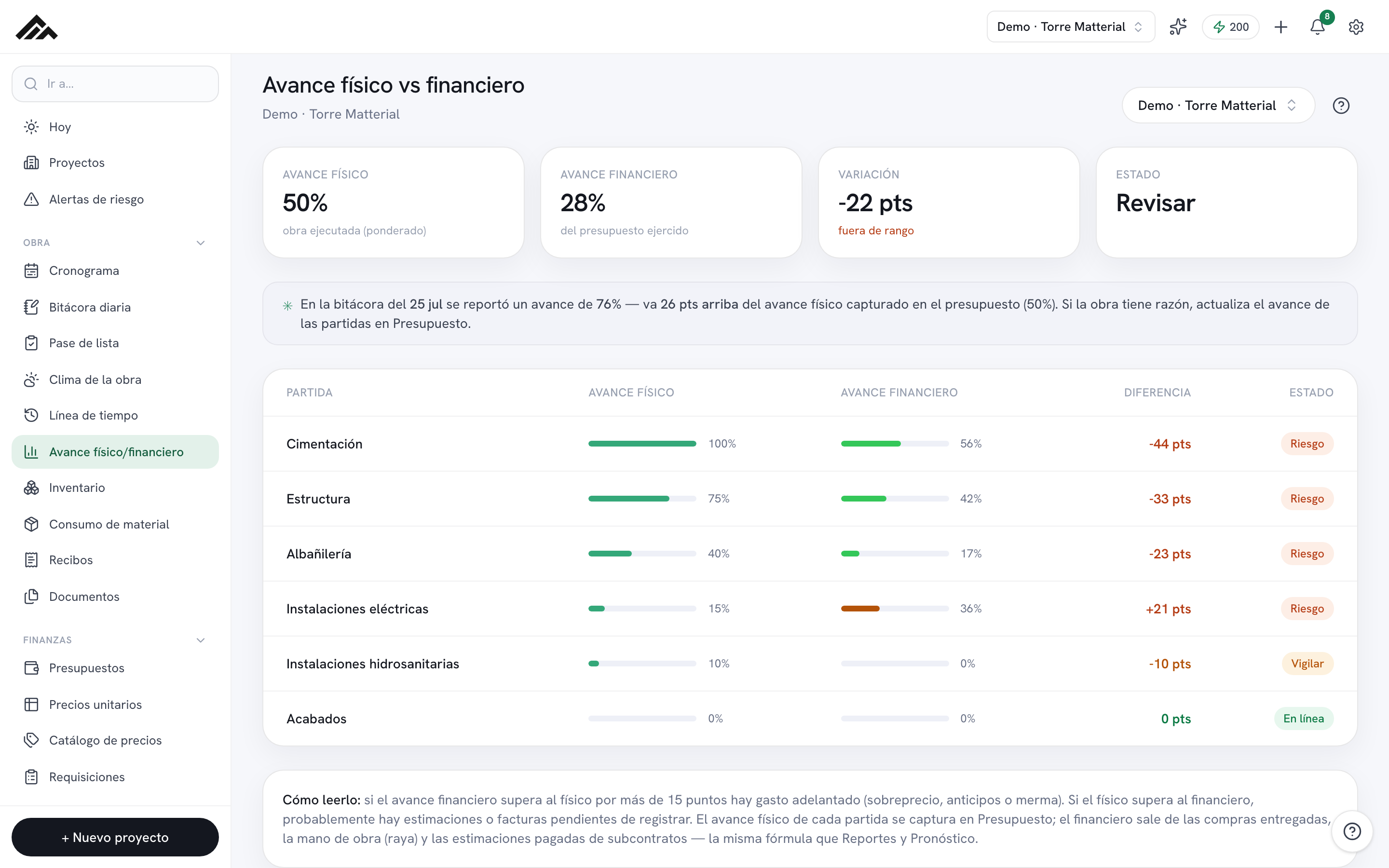
- Physical progress = work built, weighted by budget; financial progress = spent divided by planned. The gap between the two is the signal that matters.
- Four cards sum up the job at the top: physical, financial, variance (in points), and status (Under control, or Review once the variance tops 15 points).
- The table breaks down every line item with its own traffic light — On track, Watch, or At risk — depending on how far physical and financial have drifted apart.
- You don't enter physical progress here: you edit it item by item in Budget. This screen only reads and compares.
- If financial runs ahead of physical, spending is getting out in front; if physical is higher, you're probably missing progress billings or invoices you haven't logged yet. Same money math as Reports and Forecast.
- 1
Pick the project
Open Progress and, in the top right, use the project selector to point at the job you want to review. If you don't have budget line items yet, the screen hands you a button straight to Budget, because that's where the whole calculation comes from.
- 2
Read the four cards at the top
Up top you'll see Physical progress (work built, weighted by budget), Financial progress (share of the budget spent), Variance in points, and Status. When the variance climbs above 15 points, the status card flips to Review; below that, it stays Under control.
- 3
Scroll down to the line-item table
Each line item shows its physical and financial progress with a bar and a percentage, the Difference in points (+/-), and a status: On track, Watch (over 8 points), or At risk (over 15). That way you quickly spot which item is dragging the number off course instead of staring at the average alone.
- 4
Fix physical progress in Budget
This screen is read-only: each line item's physical progress is entered over in Budget, in the percentage field (0 to 100) on every item. If a number looks off, fix it there and progress recalculates on its own when you come back.
- 5
Cross-check against what the site reported
If the site engineer logged a progress percentage in the Log and it differs by 5 points or more from the calculated one, a notice appears with the date of that report and how many points it's above or below. If the field is right, update the line items' progress in Budget.
- 6
Read the variance with the built-in guide
The 'How to read it' card at the bottom brings it home: financial well above physical usually means overpricing, advance payments, or material waste; physical above financial usually means progress billings or invoices you haven't logged yet. Use that to decide where to dig in.
Frequently asked questions
Where does financial progress come from?
From spent divided by planned. Spent adds up delivered purchases, labor (payroll), and paid subcontractor progress billings — the same formula Reports and Forecast use, so the money ties out across the whole platform. Physical progress, on the other hand, is something you enter line by line in Budget.
Why doesn't physical progress match what the site engineer reports in the log?
Because they're two different sources: the physical figure on this screen is weighted from the percentages you entered in Budget, while the log is what was called in from the field. When they differ by 5 points or more, Progress flags it with a notice. If the job is on track and it's the budget figure that's stale, update it in Budget.
Does this screen use AI credits?
No. Physical and financial progress is calculated live from your budget and spending data; it doesn't use AI or draw down your company's monthly credit pool. Check it as often as you like at no cost.